A JOURNAL FROM THE NORWEGIAN OCEAN INDUSTRY AUTHORITY
Before the crisis hits
If important societal functions are to be maintained in crisis and war, the business sector has an important role to play. The industry organisation Offshore Norge points to several key issues that should be discussed and clarified – before the crisis happens.
Published:
19.05.2026
Text: Øyvind Midttun
Photo: NTB/Marit Hommedal
"It's a simple question, but a difficult one to answer briefly," says Aud Nistov of Offshore Norge when asked to assess whether the petroleum industry is prepared for crisis and war.
She believes that the Total Defence Year 2026 must be used to create a common understanding of roles, responsibilities and dependencies - both in the industry and in interaction with the authorities.
“If we read the white paper on total preparedness and what it implies, the message is clear: The whole of society must be prepared for crisis and war - civil society and each and every one of us – it´s about self-preparedness, and taking individual responsibility,” says Nistov.
“For the business community, it means something else,” she emphasises – “how businesses can help ensure that society, or “Norway Inc.", functions in a crisis or war situation.”
“We are talking about very basic functions. That most of the electricity grid is operational. That people have clean drinking water. That plumbing, heating and sanitation work. That there are transport resources to handle waste. That food can be distributed to the shops. That the health services function, in terms of personnel, operation and deliveries of medicine and equipment.”
“This list is not exhaustive,” Nitov explains, “but it illustrates the breadth of challenges to be handled.”
Supplying energy
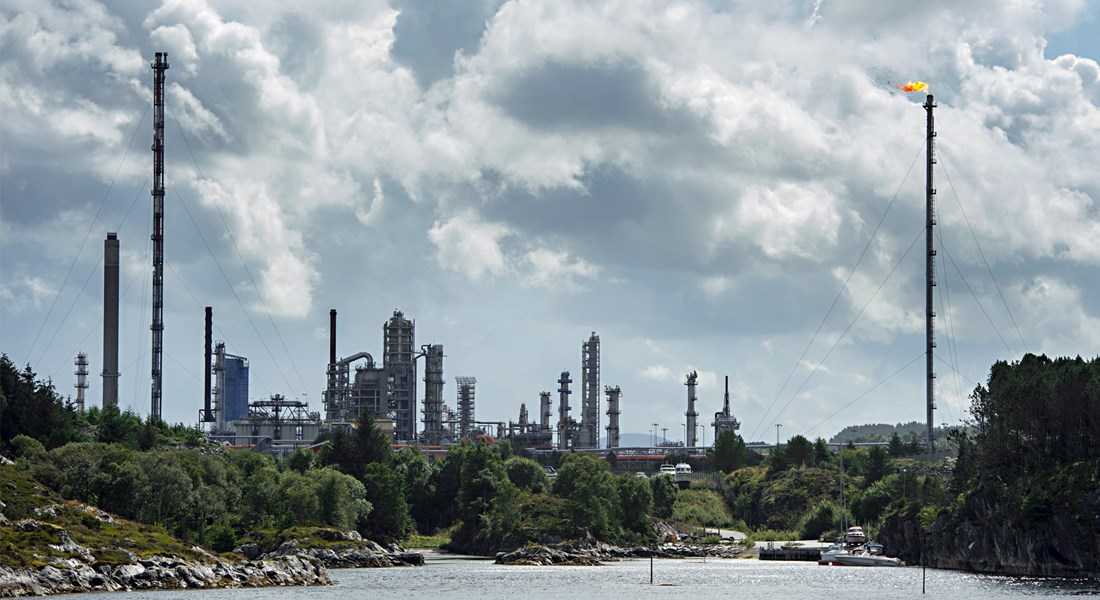
"The petroleum industry´s most important contribution to total defence is to do what we already do: Supply energy. Norwegian gas is crucial for Europe. If Norway finds itself in crisis, it is not only we who will be affected. The consequences will be felt by much of Europe," says Nistov.
She refers to new issues that have come to light this spring, not least due to the situation in the Middle East and the closure of the Strait of Hormuz.
“We are a producer of fuel and raw materials for various types of fuel, but where are we on self-sustainment? In terms of diesel, petrol and aviation fuel to the transport industry and private stakeholders - including helicopter transport to and from the Norwegian continental shelf - and for the Armed Forces?”
“Fuel supply is defined as a fundamental national function and involves meeting the needs of the Armed Forces and civilian users who are important for national security interests. We need to ask ourselves: Do today's supply chains work in a crisis or war situation? Or are there vulnerabilities that we haven´t taken seriously?”
Agreed on the decisions
In her view, it is important that such issues are discussed jointly, so that the industry, the authorities and consumers agree on the decisions to be made.
Nistov believes the most frightening outcome is that security is taken for granted. That people assume that it will "all work out", because Norway is a large petroleum nation. Too little refinery capacity or the wrong type of infrastructure can quickly prove a false sense of security in a world where supply lines do not necessarily work as they used to.
Energy is another example. An analysis was carried out of the effect on various industries if 30 percent of the energy supply was lost. Initially, the economic consequences looked surmountable, but the figures were based on inaccurate assumptions. Realistically, the consequences could be enormous. A 30% cut in an oil producer´s energy supplies could halt production completely.
Who coordinates?
Nistov also outlines challenges related to personnel and resources. Systems handling compulsory work duty and redeployment may be sensible, she says, but also raise the question of who is responsible for coordination and for avoiding or resolving conflicts.
“The same applies to transport resources. The Armed Forces increasingly use private suppliers, for example for transport capacity. But the same trucks can also be called upon by the Civil Defence or the Home Guard. Who oversees the big picture? Who ensures that the resources are, at worst, not available to anyone?”
Nistov also expresses concern about scenarios where resources such as personnel, helicopters and supply ships, are reallocated for other purposes in a crisis.
“It may then become necessary to deprioritize something else. Can we keep all the shelf activity going at the same time? Probably not. These discussions are difficult, but necessary.”
Standing strong
Despite this, she is clear that the Norwegian petroleum industry is standing strong. The industry handles preparedness and collaboration well and is advantageously positioned compared with many other countries. What is new is the security landscape.
Nistov believes that the first thing the companies must do in the Total Defence Year is to put the topic on the agenda.
“They must ask themselves fundamental questions about their role in total defence, what dependencies are most critical for the company, what must be prioritized in the event of a crisis and whether there is a gap between ambition and actual capability.”
“The industry has already put much in place. We are used to thinking about preparedness and have a system for handling crises. The challenge now is to see preparedness in a total defence context. Before the crisis happens, not afterwards.”
The business community's responsibility
The companies' most significant contribution in a crisis or war is to ensure a situation as close to normal as possible. This means that society's resources can be prioritized where they are needed most.
All businesses are encouraged to take independent responsibility for their own emergency preparedness.
Four pieces of advice from the government to the business community:
1) Keep up to date on the threat landscape
Use available assessments to understand current threats and vulnerabilities.
2) Map the company's values and vulnerabilities
Have an overview of what might make the business of interest to threat actors and how the company's vulnerabilities can be minimised.
3) Make continuity plans
Plan for operational continuity in the event of a loss of power, digital services or water supply. Practice the scenario and ensure self-preparedness within the company.
4) Use the Total Defence Year to practise
Participate in practice drills where possible.
The advice from the government to the business community is taken from a letter from the Ministry of Justice and Public Security to the Business Security Organization on 16.3.2026.
Read more articles from Dialogue no 1- 2026:
If the unthinkable should happen

The threat assessment for Norwegian petroleum activities
Preparedness in their blood

Founders arming up
From bark beetles to NATO
Dual-purpose technology
Calls for a clear mineral strategy

New status for intervention
The network beneath the waves
Safe structures and robust material choices
Would you like to receive Dialogue in print completely free of charge? Send an email to dialogue@havtil.no and state how many copies you would like.