Havtil carries out a knowledge acquisition concerning the well integrity status of temporarily abandoned wells every other year. The study began as an initiative to prevent the long-term temporarily abandonment of exploration wells without defined future plans, in addition to identify production wells with well barrier failures or compromised well integrity.
Red and orange wells
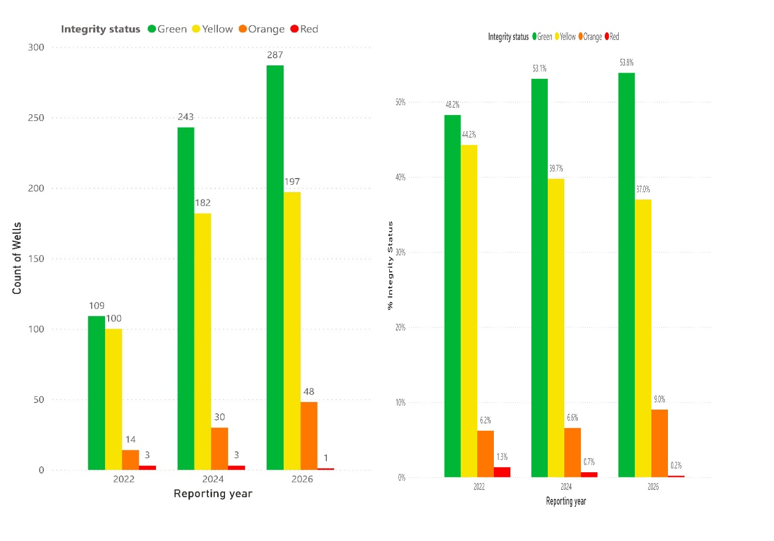
The findings in this year’s survey show that the number of wells in the orange category, where one well barrier has failed, increased from 33 in 2024 to 48 in 2026. For wells categorised as orange, the companies must implement measures to ensure regulatory compliance. Havtil monitors that the companies are implementing the plans they have reported for these wells.
Wells in the red category have a failure in one well barrier, while the other well barrier is degraded.
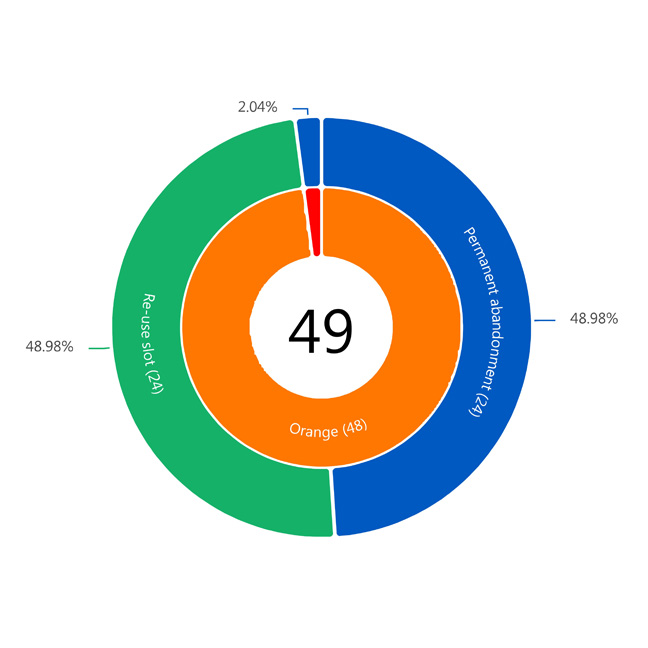
The future plan for the one red well entail ongoing permanent plugging by the end of 2026. It has been reported that half of the orange wells will either be reused by returning them to production following intervention, slot recovery or recompletion, while the other half will be permanently plugged.
Other findings
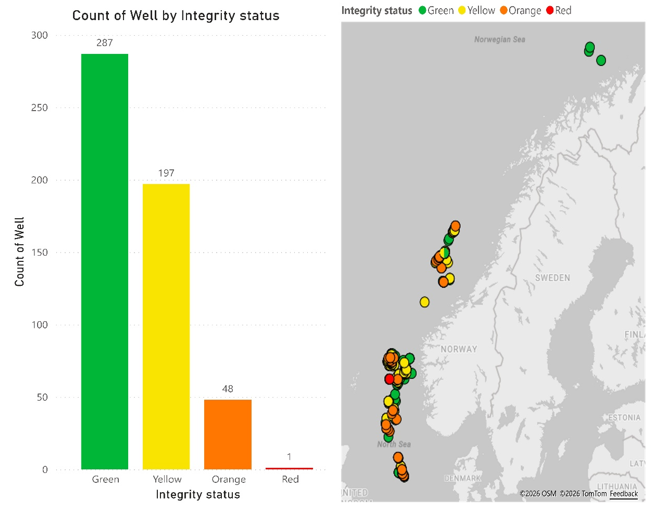
For 2026, 533 temporarily abandoned wells have been reported.
🟢 53,8 percent are classified as green
🟡 37,0 percent are yellow
🟠 9,0 percent are orange
🔴 1 red well
Temporarily abandoned wells are classified in different well integrity categories, with associated colour coding according to Offshore Norge’s guidelines 117.
In addition, categorisation according to NORSOK standard D-010 Rev 5./2021 for temporarily plugged and abandoned wells with or without continuous monitoring.
The percentage of wells with continuous monitoring is the same as was reported in 2024; 76 percent have continuous monitoring of pressure across both primary and secondary barriers, while 24 percent are not continuously monitored.
- Continuous monitoring of both well barriers: 76 percent
- Not continuous monitoring: 24 percent
The findings are made publicly available in the appended report through anonymised data.
The company THREE60 Energy AS was engaged to compile a report in the wake of the data collection which took place in March 2026. Of the 533 wells reported as temporary abandoned, 267 were inactive production wells. For the 267 inactive production wells, 253 wells have continuous monitoring of both well barriers.
Wells that have been temporarily abandoned without continuous pressure monitoring across both well barriers is found in wells with deep-set plugs and cement barriers. This category is defined as a temporarily plugged well, ref. Regulation - EU - 2024/1787 - EN - EUR-Lex, and accounts for 266 of the 533 wells.
Risks and challenges associated with re-entry
All temporarily abandoned wells must be re-entered for further use or permanent plugging. With regards to re-entry, it is a prerequisite that well integrity can be monitored by measuring the pressure across the well barriers in the flow direction. This now follows from Section 88 of the Activities Regulations regarding the securing of wells, with reference to the new guideline text:
https://www.havtil.no/en/regulations/all-acts/the-activities-regulations3/XV/88/
"In order to control the well integrity as mentioned in the fourth subsection, one should be able to monitor pressure conditions across the primary and secondary barriers."
There are risks and challenges associated with re-entering temporarily abandoned wells where well integrity is not being monitored. Experience from well incidents shows that where it is not possible to read the pressure in the wells, compensatory measures must be implemented by closing the BOP, in order to effectively divert and manage hydrocarbons returning from the wells.
Regulations
In 2014, Havtil amended the regulations to include new time frames for the temporary abandonment of exploration wells and temporarily abandoned production wells without continuous monitoring of the pressure across the well barriers.
Development wells without continuous monitoring
- Temporary abandonment: Three years (max.)
- Hydrocarbon-bearing zones must be permanently plugged and abandoned within three years.
Exploration wells
- Temporary abandonment: Two years (max.)
- Permanent plugging or re-entry required within two years.
Production wells with continuous monitoring
- Continuous monitoring of pressure across primary and secondary barriers
- May remain temporarily abandoned, provided that well integrity is maintained
https://www.havtil.no/en/regulations/all-acts/the-activities-regulations3/XV/88/
This was implemented to ensure robust follow-up and permanent plugging and abandonment within a safe time frame for wells without any further production potential.
Havtil’s expectations for the companies
- Havtil expects the companies to comply with the regulatory requirements and ensure that the re-entering of temporarily abandoned wells is conducted safely.
- For wells categorised as red or orange, the companies must implement measures to ensure regulatory compliance.
- Havtil monitors that operators follow up and secure temporarily abandoned wells in a robust and safe manner.
Trends in well integrity classification
In 2022- 2026 operators have reported temporarily abandoned wells in different well integrity categories, with associated colour coding according to Offshore Norge’s guidelines 117.
Future plans
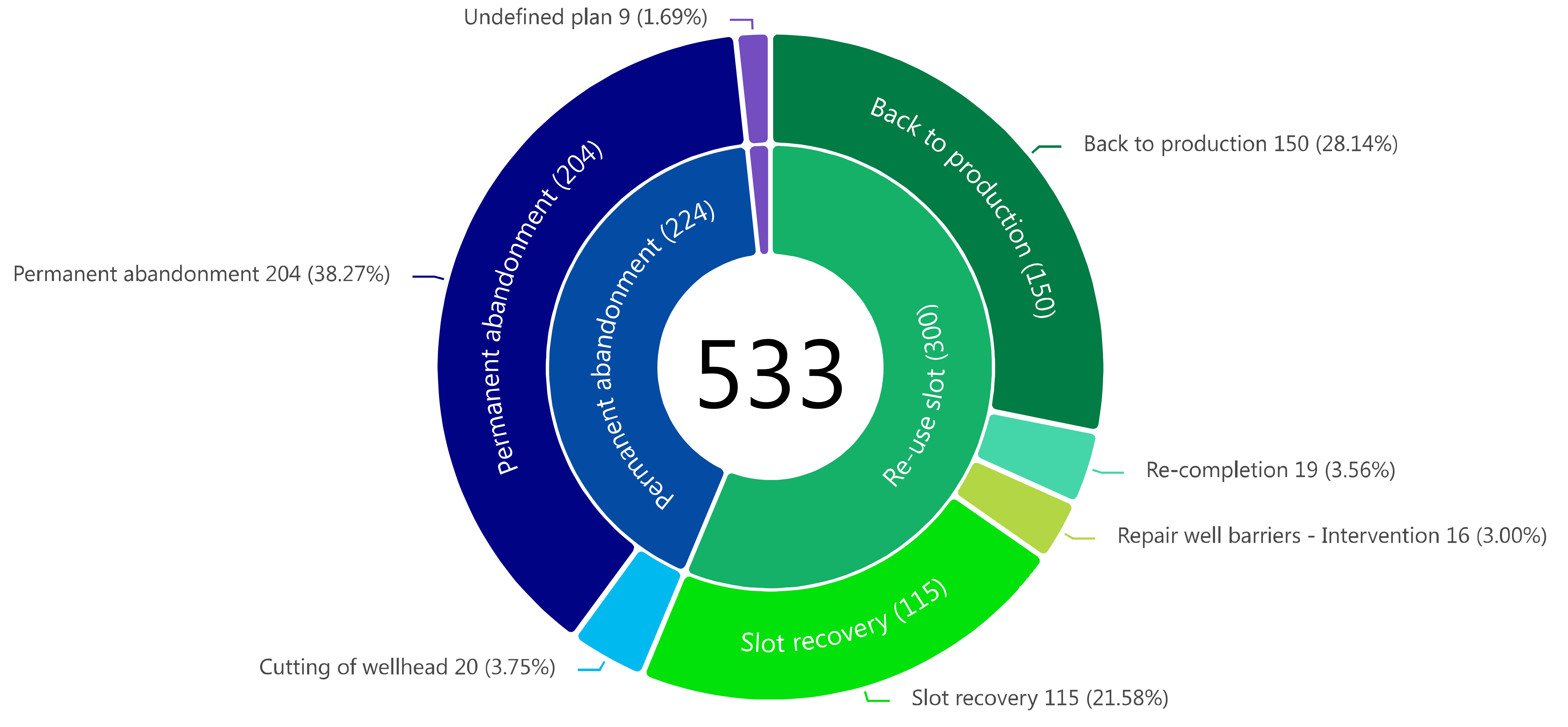
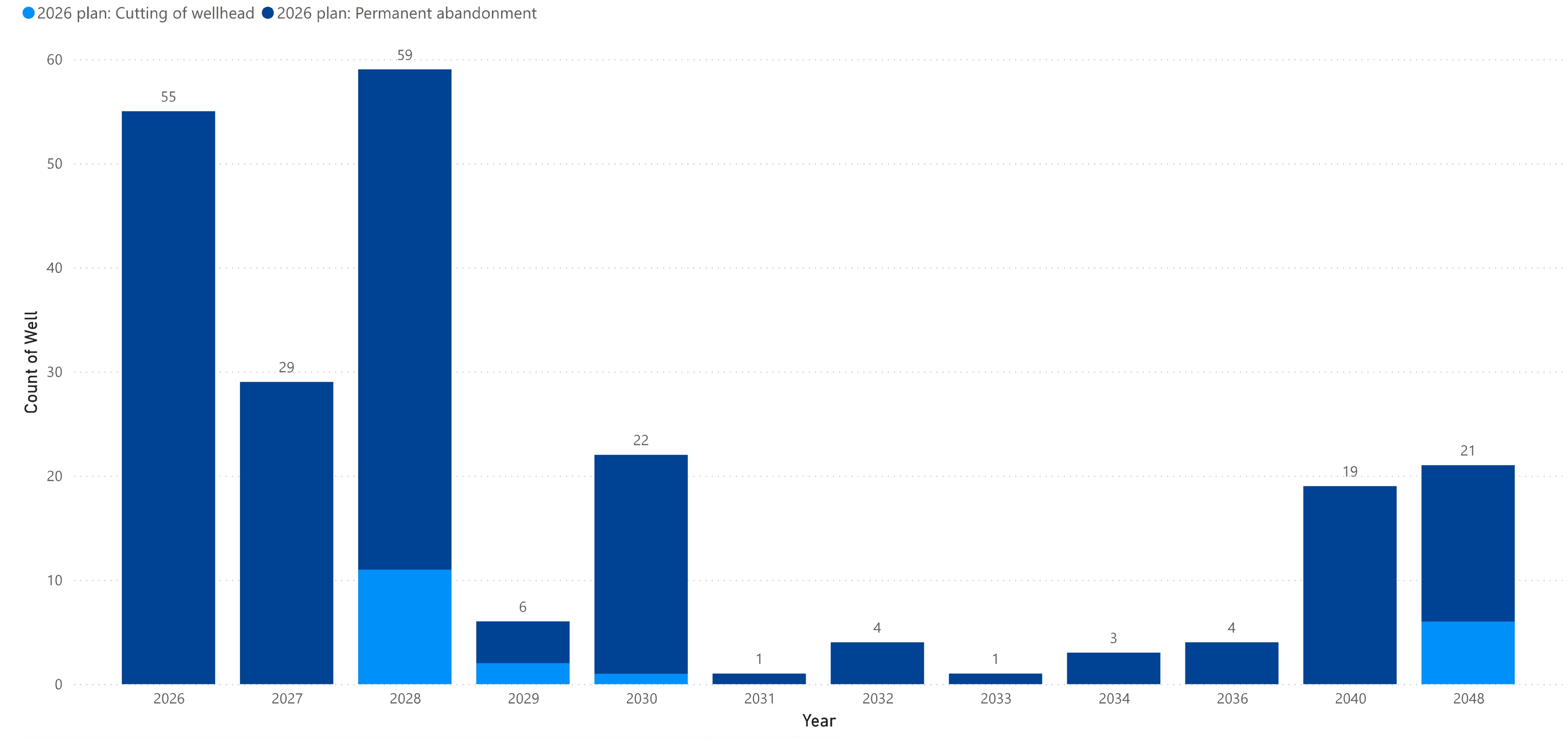
The survey shows that 224 of 533 wells are scheduled to be permanently plugged by 2050. 171 of the wells are to be permanently plugged by 2030.
For almost 300 of the wells, slot recovery or a return to production/injection is planned.
Focus areas for temporarily abandoned wells
Havtil’s focus going forward is to ensure that companies’ plans for the re-entry and follow-up of wells with degraded well integrity status (red and orange wells) are implemented.
The proportion of wells with and without continuous monitoring is stable but shows that 24 percent of the wells do not have continuous monitoring of both well barriers.
Havtil will follow up further with a study in 2027.
For more information, see the appended report.