This article was first published by the Norwegian Labour Inspection Authority, but the content is also highly relevant for the petroleum industry and other offshore sectors. The Norwegian Ocean Industry Authority has responsibility for safety, the working environment and emergency preparedness within the offshore industry.
The Norwegian Labour Inspection Authority regularly receives inquiries and tip-offs about course providers who offer courses that do not fulfil the regulatory requirements. Often this concerns providers who only offer theoretical training, typically online, without practical training being given before the course certificate is issued. Others issue course certificates that must be countersigned by third parties (employers) to document that practical training has been provided. This often makes it difficult to ensure traceable documentation of the training’s adequacy.
As a result, the Norwegian Labour Inspection Authority may reject the course certificate, and fine or sanction the employer.
What is the issue here?
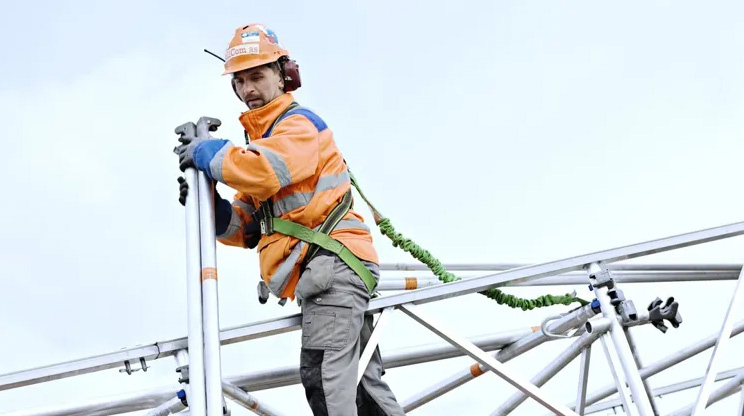
Work at height is highly dangerous, and every year sees many serious fall accidents. Due to the risk of accidents both in the erection of scaffolding and in the use of improperly installed scaffolding, the regulations impose strict requirements on the employer for documented training of anyone building, assembling, altering, dismantling and using scaffolding.
Training in both theory and practice is mandatory. Employers can use their own qualified employees to provide this training, but many opt to use external course providers to meet the training requirements.
Training is the employer’s responsibility
The Norwegian Labour Inspection Authority has no authority to prevent unprofessional course provision, outside of the schemes regulated for training provided by certified training centres. The requirement for the training to have been completed, and to be of satisfactory quality, is imposed on the employer.
Employers must therefore assent to the Norwegian Labour Inspection Authority’s rejection of course certificates where it is unable to trace who has provided the training, its content and syllabus, and whether the requirement for practice has been met. If the Norwegian Labour Inspection Authority finds that the employer has not ensured that the requirements for training in assembly, dismantling, alteration and inspection of scaffolding have been met, the Authority may both issue an order in respect of training and impose a fine for non-compliance. In the event of occupational accidents where lack of training is identified as a potential underlying cause, the employer also risks sanctions.
Other examples of online training that also require practical training are the use of fall protection equipment and personnel lifts.
The Norwegian Labour Inspection Authority also reminds employers that the training of employees must be renewed when necessary.
By press contact Selena Konjhodzic Øverjord, the Norwegian Labour Inspection.