A JOURNAL FROM THE NORWEGIAN OCEAN INDUSTRY AUTHORITY
Investing in autonomous
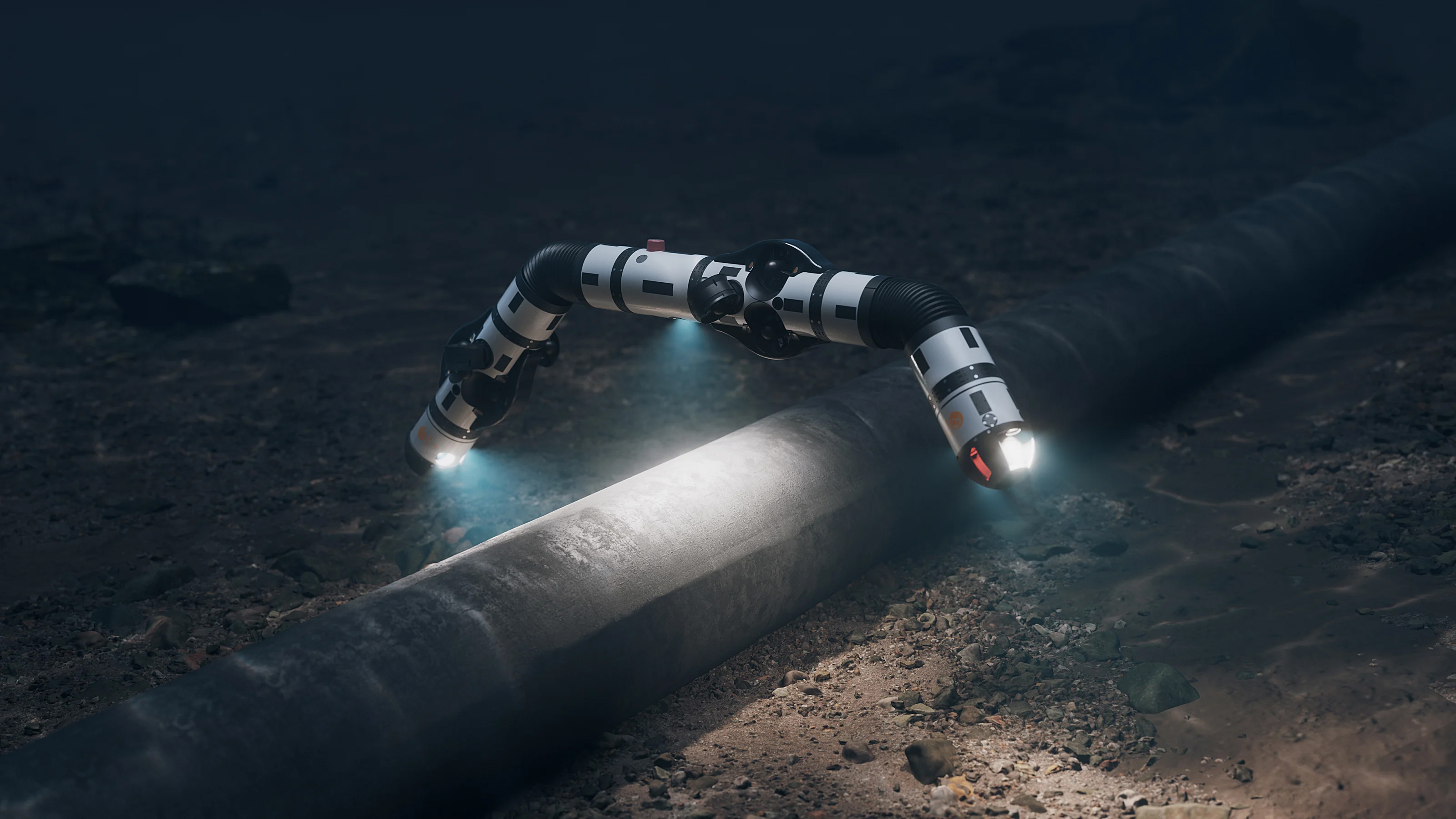 Photo: Kongsberg maritime/Eelume
Published:
10.12.2025
Text: Øyvind Midttun
Photo: Kongsberg maritime/Eelume
- Artificial intelligence
Equinor has been working for several years to develop autonomous underwater drones that can perform inspection, maintenance and repair (IMR) on the seabed. Ambitions are high - for safety, efficiency and sustainability.
Concepts involving autonomous underwater drones are currently being assessed for several Equinor-operated fields on the Norwegian continental shelf, such as Johan Sverdrup, Njord, Gullfaks and Snøhvit.
The Snøhvit field in the Barents Sea has been developed using subsea facilities and pipelines to the onshore facility at Melkøya near Hammerfest. Following the start-up of Askeladd Vest in autumn 2025, the pipeline length has been extended from 143 to around 195 kilometres. This remains one of the longest multiphase pipelines in the world, and places special demands on Snøhvit when assessing drones versus vessels.
Surveillance
According to Ståle Søyland, head of the Snøhvit Unit's steering committee, there is a great need for continuous monitoring of templates and pipelines.
"We need to monitor our infrastructure in terms of condition, technical integrity and general monitoring," says Søyland.
The usual procedure has involved carrying out inspection and potential intervention using conventional solutions. In practice, large, manned vessels have remote-controlled ROVs on board and these are launched and steered by personnel on deck.
But ROV vessels come at a cost. For a field located far north on the NCS with few neighbours to work with, the solution offers little flexibility – especially in the event of acute needs.
"Access to vessels with ROV technology requires planning. There is no guarantee that you can gain access precisely when you need it," Søyland points out.
Equinor has therefore considered using new solutions on Snøhvit, such as autonomous underwater drones that can live on the seabed for longer and carry out missions without cables.
We are moving the work from manned vessels offshore to land-based operations centers, where drones and USVs are remotely controlled and planned.
Inspection and intervention
Hans Kristian Kvangardsnes, project manager for the implementation of underwater intervention drones (UID s) and unmanned surface vehicles (USVs) in Equinor, says that autonomous underwater drones should be able to carry out both inspection and leak detection missions, as well as simple interventions such as valve operations in the long term.
"The drone will run by itself, i.e. autonomously, without control. The concept we considered for Snøhvit was that it would live on the seabed, be based in a docking station and work from there.”
Operating autonomously underwater presents technical challenges. GPS and 5G do not work on the seabed, and communication must take place via acoustics or light with limited range and bandwidth.
"GPS doesn’t exist on the seabed. Acoustics have a range of about one kilometer with low bandwidth, rather like an old-fashioned text message. Light provides high bandwidth, but only at 50 meters. You have to build an underwater network, and that´s costly," Kvangardsnes states.
Benefits
Ståle Søyland believes that the use of drones could provide both safety and environmental benefits.
"We are moving the work from manned vessels offshore to land-based operations centers, where drones and USVs are remotely controlled and planned.
This means that you can inspect more frequently and more rapidly. We will be able to detect diffuse leaks earlier than with sporadic vessel operations. If we can also replace a vessel that uses roughly 30-40 cubic meters of fuel per day with a drone that runs on batteries, the upside in terms of CO2 emissions is significant.
The Snøhvit licensees have not yet proceeded with the proposed concept. Equinor is still working on maturing the technology and considering alternative solutions.
We are looking at possible upsides using drones for the entire NCS. Our ambitions centre around safety, lower environmental emissions and the right tools for the right job.
Strategy
The company sees underwater drones as part of a broader strategy for robotization and digitalization. Its ambitions are to make operations safer, more efficient and more sustainable.
Equinor has collaborated with several technology suppliers - such as Oceaneering, Saipem, Saab and Eelume, and is in close dialogue with research environments such as the Norwegian University of Science and Technology (NTNU).
Various solutions and concepts are being tested at K-lab, Equinor's own test centre at Kårstø in Rogaland. Some of these have already been implemented, such as on the Njord field.
"We are looking at possible upsides using drones for the entire NCS. Our ambitions centre around safety, lower environmental emissions and the right tools for the right job," says Kvangardsnes.
From research to field
Norwegian firm Eelume has developed underwater drones that can live on the seabed and work around the clock. The technology is set to be introduced globally and to challenge established solutions.
The technology behind Eelume is based on advanced cybernetics and control systems developed at the Norwegian University of Science and Technology (NTNU). As early as the early 2000s, researchers began modelling the movements of snakes to create robots that could navigate autonomously in demanding environments.
"We started with the concept of a floating robot arm that could adapt in length and shape to different tasks on the seabed. Today, these have developed into autonomous drones that can live on the seabed in their own docking stations and operate 24/7," says Thomas Nygaard, the company's CEO.
Lower risk
By combining advanced robotics with sensors and on-board computing, the Eelume drones can perform inspections and mapping in one and the same operation – reducing the need for conventional ROVs and associated support vessels.
"In many cases, we remove the need for ROV and support vessels, meaning fewer operations, lower risk, significant cost savings and environmental benefits," says Nygaard.
The technology has been adapted to demanding Norwegian underwater conditions and can operate autonomously or semi-autonomously over long periods. Eelume has previously received support from the Research Council of Norway for development and demonstration, but the current agenda is focused on meeting a growing global market for autonomous underwater drones that offer smarter, safer and more cost-effective solutions.
Subsea autonomy is becoming increasingly significant, and recent years
have seen the launch of several new concepts for inspection and intervention.
Two drones, one technology
Eelume M is designed for complex subsea tasks such as inspection and maintenance of valve operations and other critical infrastructure. The drone has a snake-like, flexible body allowing it to manoeuver in tight spaces and around structures with high precision.
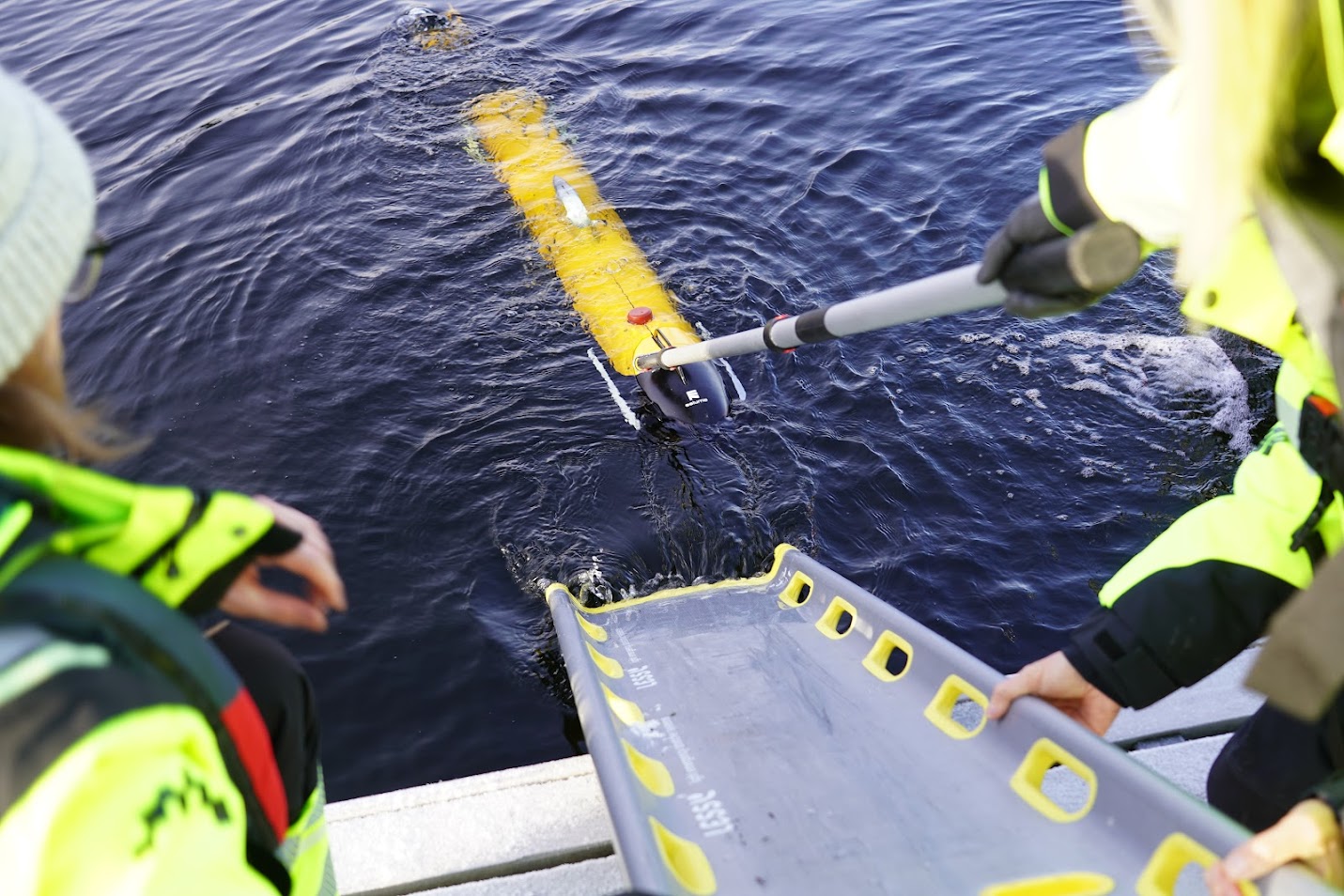
Eelume S is a lighter drone developed specifically for mapping and data collection. It is equipped with acoustic sensors, cameras and sonar with a width of up to 200 meters. It can dive vertically thanks to a steerable tail which provides significantly improved manoeuverability than traditional ROVs and AUVs, which must often dive at a 20-30-degree angle.
"Eelume S has been developed with direct input from users experienced in traditional underwater drones. The drone can handle demanding, hilly terrain, often found in the Norwegian underwater topography, and lowers the user threshold considerably," Nygaard explains.
Know too little
Subsea autonomy is becoming increasingly significant in a sea area spanning over two million square kilometres, where critical infrastructure is often located at great depths. Eelume is targeting several sectors including oil and gas, aquaculture, defence, marine archaeology and climate surveillance.
"We know too little about the ocean. If we are to manage it well, secure infrastructure, conduct sustainable aquaculture and defend our coast, we need better data. Current methods are not up to the task," says Nygaard.
"The need for precise and reliable data is increasing rapidly. We offer a solution that can not only compete in the existing market for autonomous underwater vehicles but also pave the way for completely new areas of application," says Nygaard, who believes that the demand for autonomous underwater robots will increase in the future.
Remote-controlled risk
What happens to the risk landscape when the control of underwater vehicles is moved to land?
In 2025, Havtil commissioned the research institute SINTEF to investigate developments in ROV inspection and operational activities. The focus of the assignment was land-based control rooms and potential consequences for the integrity assessments at Norwegian subsea facilities.
The report from SINTEF concludes that land-based control does not lead to fundamental changes in integrity assessments, but that all concepts have strengths and weaknesses.
The benefits include a lower carbon footprint and a better working environment. The challenges relate to communication quality, access to tools and the need for robust procedures. The recommendation is to adapt the choice of concept to the criticality of the operation and to strengthen training in line with Human Factors principles.
The full report "Investigations of advantages and disadvantages of land-managed ROV inspections and operations on subsea facilities" can be read at havtil.no (In Norwegian only)
Concepts and abbreviations
In the wake of multiple new ROV variants, equally many abbreviations have followed. For example, what do AUV, UID, AID, UVSM and RROV mean?
A conventional ROV, i.e. a remotely operated vehicle, is often launched from a manned vessel and controlled by a pilot via a joystick - with signals and data transmitted by cable.
ROVs can have manipulator arms and are widely used on the NCS for the inspection, maintenance and repair (IMR) of subsea equipment and facilities.
According to SINTEF the need for IMR using underwater vehicles will grow in the future. This is due to an increased number of subsea facilities, the ageing of existing subsea facilities and the need for follow-up of these.
In recent years, many new ROV concepts have been launched both for inspection (data collection on condition, detection of damage, wear, corrosion, etc.) and intervention (active interventions such as repair, replacement or adjustment of equipment).
Here are the most important categories:
- AUV: Autonomous Underwater Vehicle – drone that operates autonomously over time. Often used for pipeline inspection and seabed mapping
- UID: Underwater Intervention Drone - drone that can perform simple maintenance tasks (intervention)
- AID: Autonomous Inspection Drone - autonomous drone for inspection and data collection
- UVMS: Underwater Vehicle Manipulator System - underwater vehicle with manipulator arms for precision work
- RROV: Resident ROV – drone that is stationed on the seabed over time
A RROV can be stationed on the seabed for several months and housed in a "garage" that provides electricity, communication with land and access to various tools. Some have cable, others don't. Without a cable, this type of ROV can move over large distances and between different facilities.
Although interest in new ROV solutions is increasing, conventional concepts continue to dominate. SINTEF predicts that by 2025, the RROV will be used in 90–99 per cent of operations on the NCS.
Read more articles from Dialogue no 2-2025:
Articles from Dialogue no 2-2025
Would you like to receive Dialog in print completely free of charge? Send an email to dialogue@havtil.no and state how many copies you would like.